3 Clusters of Personality Disorders: Cluster A, B, and C Explained
The 3 clusters of personality disorders are a simple way to organize ten long-term personality disorder patterns into Cluster A, Cluster B, and Cluster C. These groups are not personality types, labels for everyday behavior, or shortcuts for judging someone. They are clinical categories used to describe persistent patterns in how a person relates to themselves, other people, emotions, and daily responsibilities. If your questions are mostly about rejection sensitivity, social avoidance, or whether avoidance feels stronger than ordinary shyness, an AVPD self-reflection starting point can help you organize observations before a professional conversation.
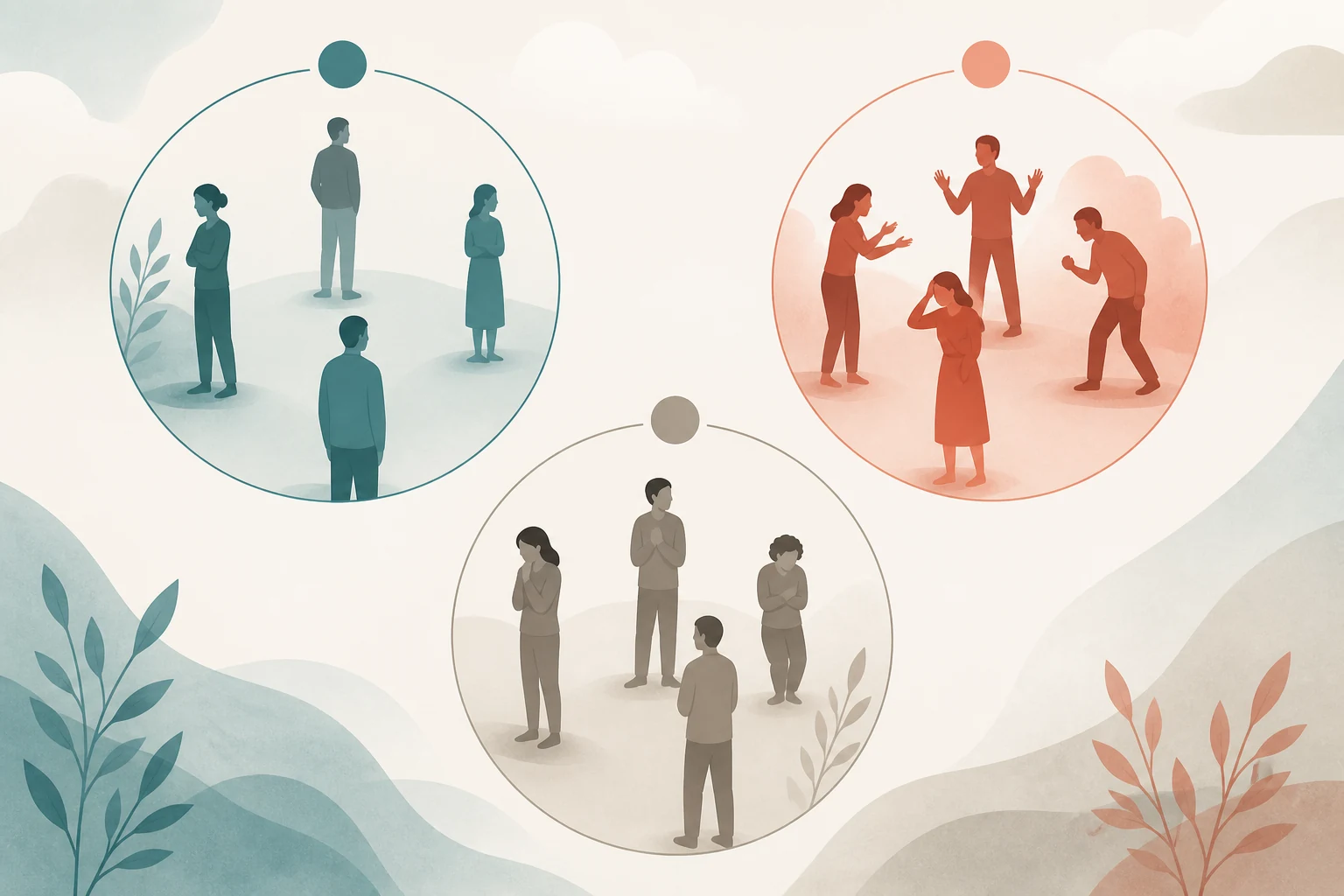
What Personality Disorder Clusters Mean
Personality disorder clusters are organizing categories. They help clinicians and educators explain broad similarities among disorders, but they do not replace a careful personal assessment. A person is not placed in a cluster because of one awkward conversation, one emotional week, or one relationship conflict. The concern is usually a lasting pattern that begins by adolescence or early adulthood, appears across settings, causes distress or impairment, and is difficult for the person to shift even when it creates problems.
The cluster model is often summarized this way: Cluster A is odd or eccentric, Cluster B is dramatic, emotional, or erratic, and Cluster C is anxious or fearful. Those words can sound blunt, so it is better to read them as shorthand for recurring patterns rather than insults. Someone in Cluster A may seem suspicious, detached, or unusual in how they interpret others. Someone in Cluster B may struggle with emotional intensity, impulse control, identity, or attention and relationship instability. Someone in Cluster C may be organized around fear, dependence, avoidance, perfectionism, or high sensitivity to criticism.
The clusters also overlap in real life. A person can have traits from more than one area, and many people who wonder about personality disorders are really trying to understand a mixture of anxiety, trauma responses, depression, attachment history, rejection sensitivity, or social learning. That is why educational articles should describe patterns without turning them into self-labels.
The 10 Personality Disorders by Cluster
The common list of personality disorders includes ten conditions across the three clusters. Cluster A includes paranoid personality disorder, schizoid personality disorder, and schizotypal personality disorder. Cluster B includes antisocial personality disorder, borderline personality disorder, histrionic personality disorder, and narcissistic personality disorder. Cluster C includes avoidant personality disorder, dependent personality disorder, and obsessive-compulsive personality disorder.
This disorder list can be useful when you are trying to understand search terms such as "Cluster B personality disorders list" or "Cluster C personality disorders list," but the names alone are not enough. Each condition has specific criteria, a broader life context, and possible overlaps with other mental health conditions. For example, avoidant personality disorder can resemble social anxiety from the outside, while schizoid personality disorder can resemble simple introversion if the emotional and relational context is ignored. Obsessive-compulsive personality disorder is also different from obsessive-compulsive disorder, even though the names sound similar.
The practical value of the cluster system is comparison. It helps you ask better questions: Is the main difficulty unusual thinking and social detachment, intense emotional and relational instability, or fear-based avoidance and control? That question is still only a starting point, but it gives structure to what can otherwise feel like a confusing list of names.
Cluster A Personality Disorders: Suspicious, Detached, or Unusual Patterns
Cluster A personality disorders are usually described as odd or eccentric. This does not mean a person is merely creative, private, introverted, or unconventional. The cluster points toward persistent difficulty relating to others because of suspiciousness, detachment, unusual beliefs, or unusual social behavior.
Paranoid personality disorder centers on pervasive distrust and suspicion. A person may interpret neutral actions as threatening, feel easily slighted, or expect others to deceive or harm them without enough evidence. The emotional tone is often guarded and defensive.
Schizoid personality disorder centers on detachment from social relationships and a restricted range of emotional expression. Someone may prefer solitude, seem indifferent to praise or criticism, and have little desire for close relationships. This is not the same as simply needing alone time after social activity.
Schizotypal personality disorder includes discomfort with close relationships plus unusual thinking, speech, beliefs, or perceptions. A person may seem socially anxious in ways connected to suspiciousness or unusual interpretations rather than only fear of embarrassment.
Cluster A can be confused with psychotic disorders, autism spectrum traits, trauma-related mistrust, or long-standing social isolation. Professional evaluation matters because the same visible behavior, such as withdrawal, may have very different roots.

Cluster B Personality Disorders: Emotional Intensity, Impulsivity, and Relationship Instability
Cluster B personality disorders are often associated with intense emotion, unstable relationships, impulsivity, attention seeking, or conflict around self-image and empathy. The word "dramatic" is sometimes used in clinical summaries, but it can sound dismissive. A more respectful way to think about Cluster B is that the person's inner experience and outward behavior may escalate quickly, especially around closeness, rejection, control, admiration, or perceived threat.
Antisocial personality disorder involves a long-term pattern of violating others' rights, disregarding rules, deceitfulness, aggression, impulsivity, or lack of remorse. It is not the same as being rebellious or disliking authority.
Borderline personality disorder often involves intense fear of abandonment, rapidly shifting relationships, identity disturbance, emotional instability, impulsive behavior, and episodes of deep distress. Many people search "bpd cluster" because BPD belongs to Cluster B, but it should not be treated as the whole cluster.
Histrionic personality disorder is associated with strong attention needs, rapidly shifting emotional expression, and discomfort when not noticed. Narcissistic personality disorder is associated with grandiosity, need for admiration, entitlement, and difficulty recognizing others' needs.
Treatment questions about Cluster B personality disorders often focus on therapy that builds emotion regulation, relationship skills, impulse awareness, and safer coping. Different approaches may be used depending on the person and the condition. Medication may sometimes help with co-occurring symptoms, but personality disorders are usually approached through psychotherapy and long-term skill building rather than a quick fix.
Cluster C Personality Disorders: Anxiety, Fear, Avoidance, and Control
Cluster C personality disorders are organized around anxious or fearful patterns. This cluster includes avoidant, dependent, and obsessive-compulsive personality disorders. The shared theme is not ordinary worry. It is a lasting pattern in which fear, self-doubt, rejection sensitivity, dependency, perfectionism, or control shape major areas of life.
Avoidant personality disorder involves social inhibition, feelings of inadequacy, and strong sensitivity to criticism or rejection. A person may want connection but avoid social, work, or romantic opportunities because the risk of embarrassment or disapproval feels too high. For readers focused on social avoidance and fear of rejection, a private avoidant traits reflection tool may offer a structured way to notice patterns while remembering that online screening is not a formal diagnosis.
Dependent personality disorder centers on an excessive need to be taken care of, difficulty making everyday decisions without reassurance, fear of separation, and trouble disagreeing because support might be lost.
Obsessive-compulsive personality disorder involves perfectionism, rigidity, preoccupation with order, and control. A person may feel that tasks must be done in the correct way, even when this damages flexibility, relationships, or efficiency. OCPD is not the same as OCD, which involves obsessions and compulsions that are experienced differently.
How is Cluster C personality disorder typically treated? In general, treatment often uses psychotherapy to build insight, flexible thinking, social and relationship skills, and gradual behavior change. For avoidant patterns, therapy may gently address negative self-beliefs, rejection sensitivity, and avoided situations. For dependent patterns, therapy may support decision-making and boundaries. For OCPD patterns, therapy may work on flexibility and tolerance of imperfection. A clinician may also address anxiety, depression, or other co-occurring concerns.

Cluster A vs Cluster B vs Cluster C: A Plain-English Comparison
A quick comparison can make the three main categories easier to remember. Cluster A is mainly about odd, suspicious, detached, or unusual ways of relating. Cluster B is mainly about emotional intensity, impulsivity, self-image, attention, empathy, and unstable relationships. Cluster C is mainly about anxiety, fear, avoidance, dependence, perfectionism, and control.
The same outward behavior can still mean different things. Social withdrawal might appear in Cluster A because closeness feels uninteresting or suspicious. It might appear in Cluster C because closeness is wanted but feared. Relationship conflict might appear in Cluster B because emotions and attachment fears move quickly, but it can also appear in Cluster C when reassurance, fear of criticism, or perfectionism shapes the relationship.
This is why online reading works best as pattern education. It can help you name questions, but it cannot settle complex mental health questions by itself. If a pattern is persistent, painful, or affecting work, school, safety, or relationships, the next step is a conversation with a qualified mental health professional.

Causes and Risk Factors Are Usually Mixed
People often search for "5 causes of personality disorder," but causes are rarely that tidy. Current clinical explanations usually point to a mix of temperament, genetics, early relationships, trauma or neglect, family environment, social learning, and repeated life experiences. These factors do not affect everyone in the same way.
It may be more useful to ask what shaped the pattern and what keeps it going now. For example, a person with avoidant traits may have learned that rejection is likely and that withdrawal reduces immediate anxiety. A person with dependent traits may have learned that independent choices feel unsafe. A person with Cluster B traits may have learned emotional strategies that once made sense under stress but now harm relationships.
None of that means blame belongs to the person or the family. It means patterns usually develop over time, and changing them often requires patience, support, and repeated practice in safer conditions.
When to Seek Professional Support
Consider professional support when personality patterns repeatedly disrupt relationships, work, school, parenting, finances, physical safety, or emotional stability. Support is also important when shame, isolation, self-harm thoughts, substance use, aggression, or severe anxiety become part of the picture.
You do not need to know the correct cluster before asking for help. It is enough to say what you notice: "I avoid people even when I want closeness," "my relationships become intense quickly," "I do not trust people's motives," or "I cannot relax unless everything is controlled." Clear examples are often more useful than trying to arrive with the perfect label.
If you use an online tool, treat the result as a reflection aid. AVPDTest.com, for example, presents itself as an educational first step for AVPD-related traits, with a 12-question screening experience, privacy-oriented self-reflection, and optional AI-generated pattern feedback. It is not a substitute for professional advice, and its results should not be used as a final answer.

A Gentle Way to Reflect on Personality Disorder Clusters
If you are reading about the 3 clusters of personality disorders because something in your own life feels familiar, slow the process down. Start with patterns, not labels. Write down situations that repeat, what you expected from others, what you felt in your body, what you did next, and what the outcome was. Over time, the repetition may reveal whether fear, distrust, emotional intensity, dependency, perfectionism, or avoidance is the central theme.
For AVPD-related concerns, pay special attention to the difference between wanting closeness and pulling away because rejection feels unbearable. That gap is one reason Cluster C can feel lonely: the person may deeply want connection but feel unsafe reaching for it. A private way to explore rejection sensitivity can be one low-pressure step for organizing your thoughts, especially before speaking with a therapist or other qualified professional.
The goal is not to force yourself into a cluster. The goal is to understand what hurts, what repeats, and what kind of support might fit. Personality patterns can be persistent, but people can still build insight, practice new responses, and receive care that respects both their history and their capacity to change.
FAQ
What are the different clusters of personality disorders?
The three clusters are Cluster A, Cluster B, and Cluster C. Cluster A includes paranoid, schizoid, and schizotypal personality disorders. Cluster B includes antisocial, borderline, histrionic, and narcissistic personality disorders. Cluster C includes avoidant, dependent, and obsessive-compulsive personality disorders.
What are the three main categories of personality disorders?
The three main categories are often summarized as odd or eccentric for Cluster A, dramatic, emotional, or erratic for Cluster B, and anxious or fearful for Cluster C. These phrases are shorthand, not complete descriptions of a person.
What are the 10 personality disorders?
The common list includes paranoid, schizoid, schizotypal, antisocial, borderline, histrionic, narcissistic, avoidant, dependent, and obsessive-compulsive personality disorders. They are grouped into Cluster A, Cluster B, and Cluster C.
Is avoidant personality disorder Cluster C?
Yes. Avoidant personality disorder is part of Cluster C, along with dependent personality disorder and obsessive-compulsive personality disorder. It is commonly associated with social inhibition, feelings of inadequacy, and sensitivity to criticism or rejection.
What are treatment options for Cluster B personality disorders?
Treatment is usually individualized and often centers on psychotherapy. Depending on the condition and person, therapy may focus on emotion regulation, relationship patterns, impulse awareness, identity, empathy, and safer coping. Medication may sometimes be used for co-occurring symptoms, but a clinician should guide that decision.
How is Cluster C personality disorder typically treated?
Cluster C treatment commonly involves psychotherapy that addresses fear-based patterns, avoidance, dependency, perfectionism, or rigid control. Therapy may include gradual skill building, work with core beliefs, relationship practice, and support for co-occurring anxiety or depression.
Can someone have traits from more than one cluster?
Yes. People can show traits that resemble more than one cluster, and many experiences overlap with anxiety, trauma, mood concerns, neurodevelopmental differences, or attachment patterns. That is one reason a careful professional assessment is important when symptoms are persistent or impairing.