AVPD Self-Worth: Conquering the Inner Critic
The silent voice that tells you you're not good enough, that others will reject you, that you don't belong—that's the inner critic. For many who struggle with traits of Avoidant Personality Disorder, this voice isn't just a fleeting thought; it's a constant companion that undermines self-worth. If you've ever felt trapped in this cycle of negative self-talk, you are not alone, and there is a path forward.
Have you ever wondered if your low self-esteem is more than just shyness? Understanding the specific patterns of this inner critic is the first step toward reclaiming your confidence. This article provides a systematic framework to reframe your self-perception and challenge the voice that holds you back. To begin understanding your own unique patterns, a confidential AVPD self-assessment can offer valuable initial insights.
This guide offers practical exercises tied to common experiences with avoidant traits, empowering you to build a stronger, more compassionate relationship with yourself.
Understanding the Inner Critic
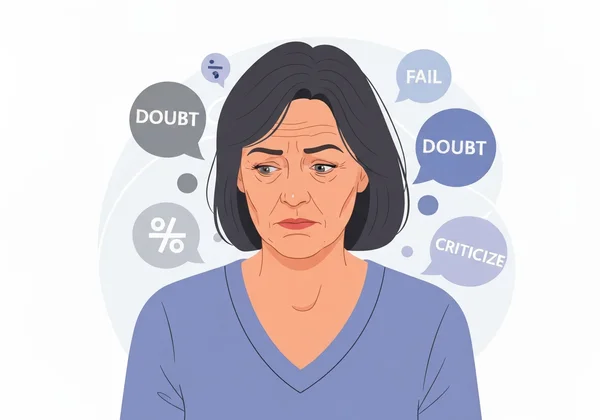
The inner critic in those with avoidant traits is more than just occasional self-doubt. It's a deeply ingrained pattern of negative self-perception that feels like an undeniable truth. It fuels the core fear of rejection and criticism, making social situations feel like minefields. By understanding its origins and function, we can begin to dismantle its power.
Why the Inner Critic Develops
This harsh inner voice often has roots in early life experiences. A childhood marked by frequent criticism, rejection, or emotional neglect can teach a developing mind that it is inherently flawed or unworthy. The brain learns to anticipate rejection to protect itself from further hurt.
Over time, this protective mechanism becomes an overactive inner critic. It internalizes the negative messages from the past and replays them constantly. The voice that once protected you from outside dangers now creates threats inside your mind. It whispers that you're inadequate, unlovable, or bound to fail before you even attempt something. This isn't a personal failing; it's a learned survival strategy that has outlived its usefulness.
Common Self-Worth Triggers in Test Responses
When you reflect on your experiences, perhaps through our online test, certain themes often emerge that highlight the inner critic at work. Questions about fearing embarrassment, avoiding new activities, or feeling socially inept directly tap into these core wounds.
For instance, a strong agreement with a statement like "I am preoccupied with being criticized or rejected in social situations" reveals the inner critic’s constant vigilance. A hesitant response to a question about personal strengths shows how effectively this critic silences any recognition of your positive qualities. These test responses aren't just data points; they are windows into the specific narratives your inner critic uses to maintain its control.
How Low Self-Worth Maintains the Avoidance Cycle
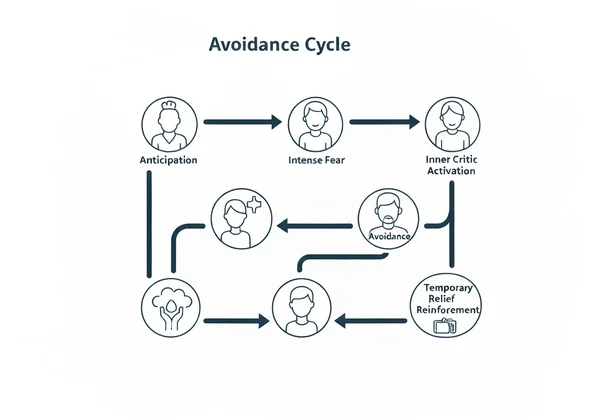
Low self-worth is the fuel that keeps the avoidance cycle running. The cycle follows this pattern:
- Anticipation of a Social Situation: First, you anticipate a social situation. This could be an invitation to a party, a work meeting, or simply an opportunity to speak up.
- Inner Critic Activation: The inner critic immediately predicts failure. "You'll say something stupid." "They won't like you." "You'll just embarrass yourself."
- Intense Fear and Anxiety: These negative thoughts trigger feelings of intense anxiety, shame, and dread.
- Avoidance: To escape these painful emotions, you avoid the situation. You decline the invitation or stay silent in the meeting.
- Temporary Relief, Long-Term Reinforcement: You feel immediate relief from the anxiety, which reinforces the idea that avoidance was the right choice. However, it also reinforces the inner critic's belief: "See? I was right to be scared. I am not capable." This deepens feelings of inadequacy and low self-worth, making the next situation even harder to face.
Breaking this cycle requires directly challenging the inner critic and the low self-worth it perpetuates.
Step-by-Step Cognitive Restructuring Framework
Cognitive restructuring is a powerful technique for challenging and changing unhelpful thought patterns. It involves treating your negative thoughts not as facts, but as hypotheses to be examined. This framework guides you through the process of dismantling the inner critic's arguments.
Identifying Negative Self-Perception Patterns
The first step is to become aware of your inner critic’s voice. For one week, carry a small notebook or use a notes app on your phone. Your goal is to catch your negative automatic thoughts as they happen. Write down the thought exactly as it occurred.
Notice common themes. Do your thoughts often involve words like "always," "never," or "should"? Do they fall into patterns like:
- Mind Reading: Assuming you know what others are thinking ("They think I'm boring").
- Catastrophizing: Expecting the worst-case scenario ("If I speak up, I'll be fired").
- Labeling: Attaching negative labels to yourself ("I'm a failure").
Simply observing these patterns without judgment is a crucial first step.
Evidence Collection Challenge: Finding Contradictory Evidence
Once you've identified a recurring negative thought, treat it like a prosecutor's claim in a courtroom. Your job is to be the defense attorney and find evidence that contradicts it.
Let's say the thought is: "I am completely incompetent at my job."
Ask yourself:
- "Is there any evidence that this thought might not be 100% true?"
- "Can I think of one time I completed a task successfully?"
- "Has a colleague ever given me positive feedback?"
- "Did I learn a new skill last month, even if it was small?"
Write down every piece of evidence you can find, no matter how minor it seems. The goal isn't to pretend you're perfect, but to prove that the absolute, all-or-nothing statement from your inner critic is inaccurate.
Creating Balanced Self-Statements
After collecting your evidence, the next step is to create a more balanced and realistic thought to replace the original one. This new thought should acknowledge the complexity of reality.
- Original Thought: "I am completely incompetent at my job."
- Contradictory Evidence: "I successfully finished the report on Tuesday. My boss said 'thank you' for my help last week. I struggle with public speaking, but I am good at data analysis."
- Balanced Statement: "I sometimes struggle with certain aspects of my job, like public speaking, but I am skilled in other areas and am capable of doing good work."
This new statement isn't overly positive; it's simply more accurate. It acknowledges the challenges while also recognizing your strengths.
Implementing Daily Self-Worth Affirmations
Affirmations are most effective when they are believable and reflect the balanced statements you've created. Generic phrases like "I am perfect" can feel false and be rejected by your brain. Instead, use your new, balanced thoughts as daily affirmations.
Choose one or two of your balanced statements. Repeat them to yourself in the morning, before a challenging situation, or whenever the inner critic becomes loud. For example:
- "It's okay to feel anxious, but I am capable of handling this meeting."
- "I have value, even if I make a mistake."
- "I am learning and growing, and that is enough."
Consistency is key. You are creating new neural pathways, training your brain to consider a more compassionate and realistic perspective.
Practical Self-Esteem Building Exercises
Alongside cognitive work, practical exercises can help build a foundation of self-worth from the ground up. These activities focus on action and experience, providing tangible proof to counter the inner critic's narrative.
The Self-Compassion Journal Template
Self-compassion is about treating yourself with the same kindness you would offer a friend. When you're struggling, try this journaling exercise:
- Acknowledge the Pain: Write down what you're feeling without judgment. "I feel so ashamed about what I said in that conversation. I'm anxious that they think I'm an idiot."
- Recognize Common Humanity: Remind yourself that making mistakes and feeling this way is part of being human. "Everyone has awkward moments. It's a normal part of life to sometimes say the wrong thing."
- Offer Yourself Kindness: Write down what a kind, supportive friend might say to you. "You were trying your best. It's okay. This one moment doesn't define you. Be gentle with yourself."
Doing this regularly helps retrain your response to perceived failures from harsh self-criticism to gentle self-support.

Gradual Exposure to Self-Acknowledgment
The inner critic thrives when you hide your accomplishments. This exercise involves gently and gradually getting used to acknowledging your own value.
Start small. At the end of each day, write down one thing you did well. It could be as simple as "I made a healthy lunch" or "I finished a difficult email." The goal is not to be boastful, but to simply state a fact without dismissing it.
As this becomes easier, you can try sharing a small success with a trusted friend or family member. This is a form of exposure therapy—facing the fear of being seen in a positive light in a safe, controlled way. Each time you do this without a negative outcome, you weaken the inner critic's power.
Strengthspotting: Recognizing Your Positive Qualities
People with avoidant traits often find it nearly impossible to name their own strengths. This exercise helps you gather objective data.
- Step 1: Write down a list of positive qualities (e.g., kind, loyal, creative, persistent, observant, good listener).
- Step 2: Think about characters in books or movies you admire. What qualities do they have that you also possess, even in a small way?
- Step 3 (If you feel ready): Ask one or two trusted friends or family members to name three things they appreciate about you.
Collect these words in a list. When your inner critic tells you that you have no value, read this list. It is your evidence file, a reminder of the qualities that are truly part of who you are. Gaining clarity on your unique profile of traits can be an empowering process, and a free AVPD screening tool is one way to start that exploration.
Your Journey to Lasting Self-Worth
Overcoming your inner critic takes time and patience. Think of it as building a new relationship with yourself—one that grows stronger with daily, compassionate effort. The voice of self-criticism may have been with you for a long time, but it does not have to define your future.
The key takeaways from this guide are:
- Understand the Critic: Recognize that your inner critic is a learned, protective mechanism, not a reflection of your true value.
- Challenge Your Thoughts: Actively question negative self-talk. Gather evidence, create balanced statements, and practice self-compassion.
- Take Small Actions: Use journaling, gradual exposure, and strength-spotting to build tangible proof of your worth.
This journey begins with self-awareness. Understanding the specific ways these patterns manifest in your life is a crucial first step. If you're ready to gain deeper insight into your own traits, start your test today. It’s a free, confidential tool designed to provide clarity and empower you on your path to healing.
The Takeaway
How do I know if my low self-esteem is related to avoidant traits?
While many people experience low self-esteem, in this context it is typically pervasive, severe, and directly linked to an intense fear of rejection and social avoidance. When feelings of worthlessness stop you from pursuing relationships, career goals, or new experiences due to fear of criticism, it could indicate underlying avoidant traits. Taking a confidential online AVPD test can help you see if your experiences align with the established criteria.
Do these self-worth exercises make a real difference for those with avoidant personality traits?
Many people find they do. Building self-worth is a core component of managing avoidant personality traits. When you begin to see yourself as a person of value, the fear of rejection lessens. These exercises help you build an internal source of validation, so you become less dependent on the approval of others. This, in turn, can make it easier to take social risks and break the cycle of avoidance.
What if my inner critic feels too strong to challenge?
This is a very common feeling. When a thought pattern is deeply ingrained, it can feel like an unstoppable force. The key is to start small. Don't try to defeat the critic in one day. Your first goal is simply to notice it without believing it. The act of labeling a thought—"There's the inner critic again"—creates a small space between you and the thought. From that space, you can begin to apply the gentle exercises of evidence-gathering and self-compassion.
How long does it typically take to see improvement in self-worth?
There is no fixed timeline, as everyone's journey is unique. However, with consistent practice of these cognitive and behavioral exercises, many people begin to notice small shifts within a few weeks. You might first notice that you catch the inner critic faster, or that a negative thought doesn't spiral into a full day of low mood. Lasting change is gradual and comes from persistent effort over months. Be patient and compassionate with yourself throughout the process.