AVPD vs Schizoid PD: Key Differences in Symptoms & Social Withdrawal
Are you grappling with persistent social withdrawal, unsure if it's AVPD or something else? Many people confuse Avoidant Personality Disorder (AVPD) with Schizoid Personality Disorder (SPD) because they both involve social isolation. However, the reasons behind this isolation are fundamentally different. Understanding this distinction is a crucial step toward self-awareness.
Let's unpack what sets AVPD apart from SPD – and where they overlap – so you can spot your own patterns. By exploring the underlying motivations, symptoms, and emotional experiences of each, you can gain the clarity you need to better understand your own unique patterns. If you're looking to explore your traits further, a confidential online AVPD test can offer valuable preliminary insights.

Understanding Avoidant Personality Disorder (AVPD)
Avoidant Personality Disorder (AVPD) involves constant social inhibition. It stems from deep feelings of inadequacy. People with AVPD are also hypersensitive to criticism. They often want to connect with others but are held back by an overwhelming fear of rejection.
Key Symptoms & Characteristics of AVPD (DSM-5 Aligned)
According to the diagnostic criteria outlined in the DSM-5 (the standard classification of mental disorders), the signs of AVPD often include:
- Avoiding activities that involve significant interpersonal contact due to fears of criticism, disapproval, or rejection.
- Unwillingness to get involved with people unless certain of being liked.
- Showing restraint within intimate relationships because of the fear of being shamed or ridiculed.
- Preoccupation with being criticized or rejected in social situations.
- Inhibition in new interpersonal situations because of feelings of inadequacy.
- Viewing oneself as socially inept, personally unappealing, or inferior to others.
- Unusual reluctance to take personal risks or engage in new activities because they may prove embarrassing.
The Underlying Fear: Why AVPD Drives Avoidance
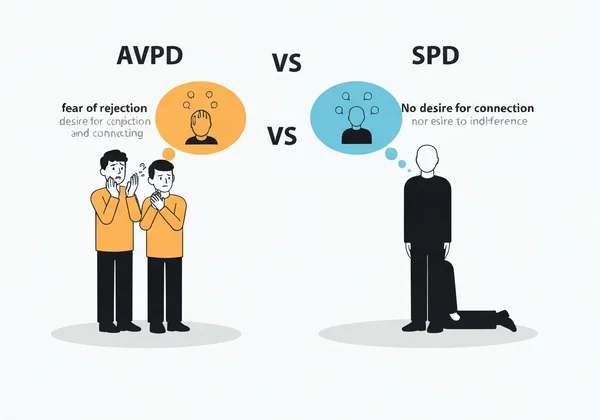
The central theme of AVPD is fear. Avoidance in AVPD is a shield. It comes from believing you're not good enough. Rejection feels inevitable. This isn't a simple case of shyness; it's a crippling anxiety that can prevent someone from pursuing jobs, friendships, and relationships they secretly long for. The internal world of someone with AVPD is often filled with a painful conflict: a strong desire for connection clashing with an even stronger fear of it.

Exploring Schizoid Personality Disorder (SPD)
Schizoid Personality Disorder is part of the same "cluster" of personality disorders as AVPD but is marked by a pervasive pattern of detachment from social relationships and a restricted range of emotional expression. Unlike those with AVPD, individuals with SPD genuinely prefer to be alone.
Key Symptoms & Characteristics of SPD (DSM-5 Aligned)
The DSM-5 outlines several key characteristics that point toward Schizoid Personality Disorder. An individual with SPD traits typically:
- Neither desires nor enjoys close relationships, including being part of a family.
- Almost always chooses solitary activities.
- Has little, if any, interest in having sexual experiences with another person.
- Takes pleasure in few, if any, activities.
- Lacks close friends or confidants other than first-degree relatives.
- Appears indifferent to the praise or criticism of others.
- Shows emotional coldness, detachment, or a flattened affect (limited emotional expression).
The Nature of Detachment: What Drives Schizoid Isolation
The primary driver of isolation in SPD is not fear, but a fundamental lack of desire for social connection. An individual with schizoid traits isn't avoiding people because they're afraid of being hurt; they simply don't feel the inherent need or pull for social bonding that most people do. They are often content and comfortable in their solitude. This internal state of indifference is the main factor that distinguishes their isolation from the fear-based avoidance of AVPD.

AVPD vs Schizoid PD: Pinpointing the Key Differences
While both conditions result in social isolation, their internal worlds are vastly different. Understanding these differences is key to identifying the correct pattern. If these distinctions resonate with you, you can always explore your traits with a focused self-assessment.
Emotional Expression: Fear vs. Indifference
The clearest difference lies in the emotional experience.
- AVPD: Individuals with avoidant traits feel emotions deeply. They experience intense anxiety, longing, and sadness related to their isolation. Their outer emotional expression might seem flat, but this is a result of inhibition and fear of showing vulnerability, not a lack of feeling.
- SPD: Individuals with schizoid traits genuinely experience a restricted range of emotions. They often appear aloof, cold, and detached because their internal emotional landscape is less varied and intense. Praise and criticism often have little to no visible impact on them.
Social Interaction: Avoidance Due to Anxiety vs. Lack of Desire
Their approach to social situations also reveals a fundamental distinction.
- AVPD: A person with AVPD avoids social events out of an active, painful fear. They may want to go to the party but are paralyzed by thoughts of what could go wrong: "What if I say something stupid? What if no one talks to me?" This avoidance is a source of distress.
- SPD: A person with SPD would likely not even consider going to the party. If they did, they would feel no anxiety, only a lack of interest or a sense that it’s a waste of time. They simply prefer to be doing something else on their own.
Relationships: Craving Connection vs. Contentment with Solitude
Finally, their desires regarding relationships are polar opposites.
-
AVPD: The tragedy of AVPD is that individuals often deeply crave intimacy and connection. They may have rich fantasy lives about friendships and romance but feel incapable of achieving them in reality due to their fears. Their loneliness is a source of significant pain.
-
SPD: Individuals with SPD typically have little to no interest in forming close bonds. They are not lonely in the traditional sense because they are content with their solitude. The idea of a close romantic relationship or a tight-knit group of friends holds little appeal.
Overlaps & Misconceptions Between AVPD and SPD
It's easy to see why these two personality disorders are often confused. From the outside, the behavior can look identical, which leads to common misconceptions.
Shared Traits: Superficial Similarities in Social Withdrawal
An observer might see someone from either group and simply label them a "loner." Both individuals with AVPD and SPD tend to:
- Have few or no close friends.
- Spend a lot of time alone.
- Appear quiet and reserved in social settings.
- Avoid engaging in group activities.
This surface-level behavior is what makes a clear distinction so important. The "why" behind the behavior is what truly matters.
Why the Confusion? Distinguishing Subtle Nuances
The confusion arises because we can only see behavior, not motivation. We see someone sitting alone and can't know if they are lonely and afraid (AVPD) or content and uninterested (SPD). You can't tell by actions alone. Dig into the 'why': fear or preference?
When to Seek Professional Insight
While articles like this can provide clarity, self-assessment has its limits. It’s important to approach this journey with a responsible perspective.
Disclaimer: This article and the tools on this website are for educational and self-exploration purposes only. They are not a substitute for a professional diagnosis from a qualified healthcare provider.
Recognizing When Self-Assessment Isn't Enough
Is social withdrawal causing you real distress? Is it hurting your work or school? Holding you back from the life you want? That's when self-assessment alone falls short. An online screening can be an excellent first step to organize your thoughts and identify potential patterns, but it cannot replace a conversation with a mental health professional.
The Value of a Comprehensive Evaluation
A licensed therapist, psychologist, or psychiatrist can conduct a comprehensive evaluation. This process involves more than just a questionnaire; it's a conversation where a professional can understand the nuances of your history, feelings, and experiences. They can accurately distinguish between AVPD, SPD, social anxiety, and other conditions, providing you with a clear and reliable diagnosis that can guide effective treatment and support.
Your Path to Clarity: Understanding & Moving Forward
Distinguishing between AVPD and Schizoid PD comes down to one central question: Is your social isolation driven by a fear of connection or a lack of desire for it?
AVPD is characterized by a painful longing for closeness, thwarted by an intense fear of rejection. SPD is defined by a genuine indifference and preference for a solitary life. Spotting fear versus indifference? That's the game-changer for figuring out your next step.
If you read this and found yourself identifying more with the fear-based patterns of AVPD, the next step on your path to clarity is gentle self-exploration. Gaining a deeper understanding of these traits is empowering. To begin this process in a safe and private way, consider taking a confidential screening.
Start the free assessment to get instant insights into your personal traits and take a meaningful step on your journey of self-discovery.
Frequently Asked Questions About Avoidant and Schizoid Traits
Can AVPD Be Mistaken for Just Being Shy?
Yes, but they are different. Shyness is a common personality trait that causes nervousness in some social situations. AVPD, however, is a pervasive, life-altering condition where feelings of inadequacy and fear of rejection are so intense that they severely limit a person's ability to form relationships and function in daily life.
What Are the Main Triggers for Avoidant Behaviors?
For someone with AVPD, the main triggers are situations that involve potential evaluation or criticism. This can include job interviews, public speaking, meeting new people, going on a date, or even expressing an opinion in a group of acquaintances. The central trigger is any situation where they might be negatively judged.
How Does an AVPD Screening Tool Help Differentiate?
A well-designed AVPD screening tool helps by asking questions that target the specific motivations and feelings behind social avoidance. Instead of just asking if you spend time alone, it probes whether this is due to fear, feelings of inadequacy, and a fear of criticism—hallmarks of AVPD—which helps separate it from other reasons for isolation.
Is It Possible to Have Both AVPD and Schizoid PD?
While it is clinically possible to have traits of more than one personality disorder, a dual diagnosis of both AVPD and SPD is very rare because their core motivations (fear vs. indifference) are contradictory. Unraveling such complex presentations requires a thorough evaluation by a mental health professional.