Types of Personality Disorders and the 3 Clusters Explained
Searches for the types of personality disorders often come from a very human place: someone is trying to make sense of patterns in relationships, emotions, trust, fear, or self-image. The helpful starting point is not to label yourself or someone else. It is to understand the broad map. Modern clinical references commonly describe 10 personality disorders, grouped into three clusters: Cluster A, Cluster B, and Cluster C. If your main question is about fear of rejection, social avoidance, or avoidant traits, an AVPD traits self-reflection tool can be a gentle educational starting point while you keep in mind that only a qualified mental health professional can provide a formal diagnosis.

What Personality Disorder Types Actually Mean
Personality disorder types are not the same as ordinary personality styles. Everyone has traits, preferences, habits, and coping patterns. A personality disorder is considered when long-lasting patterns in thinking, emotion, behavior, self-image, and relationships become rigid enough to cause distress or make daily functioning harder.
That distinction matters because a person can be shy without having avoidant personality disorder, dramatic without having histrionic personality disorder, orderly without having obsessive-compulsive personality disorder, or confident without having narcissistic personality disorder. The word disorder points to persistence, impairment, and difficulty adapting across different parts of life.
The three-cluster system is a teaching framework. It helps readers group similar patterns, but it does not mean every person inside a cluster looks the same. Many people also have overlapping traits, anxiety, depression, trauma history, or relationship stress that complicates the picture. The best use of the cluster model is to organize questions, not to force people into boxes.
Quick Map of the 10 Personality Disorders
The commonly listed 10 types of personality disorders are usually grouped like this:
| Cluster | Shared theme | Personality disorder types |
|---|---|---|
| Cluster A | Unusual, suspicious, or detached patterns | Paranoid, schizoid, schizotypal |
| Cluster B | Intense emotion, attention, impulsivity, or unstable relationships | Antisocial, borderline, histrionic, narcissistic |
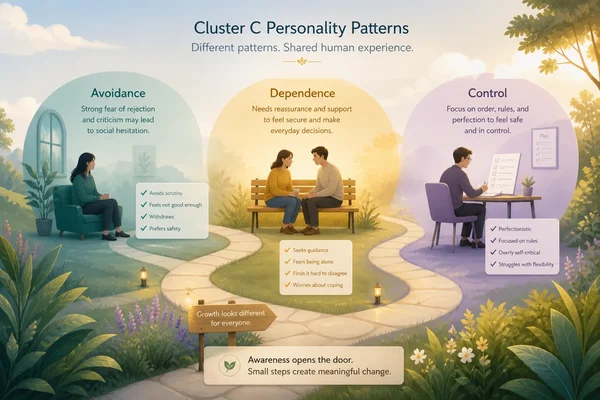
| Cluster C | Anxiety, fear, avoidance, dependence, or control | Avoidant, dependent, obsessive-compulsive personality disorder |
This table is a map, not a scorecard. It is possible to recognize a few traits from more than one category without meeting criteria for a personality disorder. It is also possible for symptoms to be better explained by another mental health condition, grief, stress, substance use, neurodevelopmental differences, cultural context, or a medical issue. That is why careful professional evaluation matters when symptoms are intense, long-running, or disruptive.

Cluster A Personality Disorders: Suspicion, Detachment, and Unusual Beliefs
Cluster A personality disorders are often described as involving odd, eccentric, suspicious, or socially detached patterns. The common thread is difficulty with trust, closeness, or shared social reality, though each type has a different shape.
Paranoid Personality Disorder
Paranoid personality disorder is associated with a persistent pattern of mistrust and suspicion. A person may often read neutral events as threatening, doubt other people's loyalty, hold grudges, or worry that private information will be used against them. This is different from having a cautious temperament after a painful experience. The concern becomes more serious when suspicion is broad, rigid, and damaging across relationships or work.
Schizoid Personality Disorder
Schizoid personality disorder is linked with emotional detachment and limited interest in close relationships. A person may prefer solitary activities, seem indifferent to praise or criticism, and show a restricted range of emotional expression. This is not simply introversion. Many introverted people value close relationships and emotional connection; schizoid patterns are usually more pervasive and detached.
Schizotypal Personality Disorder
Schizotypal personality disorder may involve unusual beliefs, eccentric behavior, odd speech, suspiciousness, and discomfort with close relationships. Some people may experience ideas of reference, meaning they interpret unrelated events as personally meaningful. The key is not that someone is creative, spiritual, or unconventional. The issue is whether unusual thinking and interpersonal discomfort create ongoing distress or impairment.
Cluster B Personality Disorders: Emotion, Impulsivity, and Relationship Instability
Cluster B personality disorders are often described as dramatic, emotional, erratic, or impulsive. This language can sound harsh, so it helps to translate it into everyday terms: intense feelings, unstable self-image, attention needs, difficulty with empathy, boundary problems, or risky behavior can place relationships under strain.
Antisocial Personality Disorder
Antisocial personality disorder is associated with a long-term disregard for the rights, safety, or needs of others. Patterns may include deceit, repeated rule-breaking, impulsivity, aggression, irresponsibility, or lack of remorse. It is not the same as being socially distant or rebellious. The pattern involves harm, violation, and repeated disregard for consequences.
Borderline Personality Disorder
Borderline personality disorder is linked with intense emotion, unstable relationships, fear of abandonment, impulsivity, shifting self-image, and sometimes self-harm risk. BPD is often deeply painful for the person experiencing it, not just difficult for others. Searchers sometimes ask whether life is worth living with BPD. The compassionate answer is yes: many people build meaningful lives with appropriate care, skills, support, and time. If someone feels at immediate risk of harming themselves, they should contact local emergency services or a crisis support line right away.
Histrionic Personality Disorder
Histrionic personality disorder involves a persistent pattern of attention-seeking and intense emotional expression. A person may feel uncomfortable when not the center of attention, use appearance or dramatic expression to draw focus, or experience emotions that shift quickly. This is not the same as being expressive or outgoing. The concern is when the pattern becomes inflexible and repeatedly disrupts relationships or self-worth.
Narcissistic Personality Disorder
Narcissistic personality disorder is associated with grandiosity, need for admiration, entitlement, sensitivity to criticism, and difficulty recognizing other people's feelings. Online discussions often flatten narcissism into an insult, but the clinical concept is more specific. It can include fragile self-esteem under the surface, and it should not be used casually to label every selfish or difficult person.

Cluster C Personality Disorders: Fear, Avoidance, Dependence, and Control
Cluster C personality disorders are commonly connected by anxious or fearful patterns. For readers of AVPDTest.com, this cluster is often the most relevant because avoidant personality disorder sits here alongside dependent and obsessive-compulsive personality disorder. If rejection fear or social avoidance is the main concern, a private avoidant personality screening resource may help you organize what you are noticing before you decide whether to discuss it with a professional.
Avoidant Personality Disorder
Avoidant personality disorder is associated with social inhibition, feelings of inadequacy, and strong sensitivity to criticism or rejection. A person may want closeness but hold back because rejection, embarrassment, or disapproval feels too painful to risk. This difference matters: AVPD is not simply preferring solitude. Many people with avoidant traits want friendship, intimacy, or recognition, but fear makes approach feel unsafe.
AVPD can overlap with social anxiety, low self-worth, attachment wounds, depression, or trauma-related patterns. That overlap is one reason self-reflection tools should be treated as educational, not final. They can help name experiences and prepare better questions, but they cannot replace a full professional evaluation.
Dependent Personality Disorder
Dependent personality disorder involves a strong need to be cared for, difficulty making everyday decisions without reassurance, fear of separation, and trouble disagreeing because approval feels essential. A person may stay in unhealthy relationships or tolerate poor treatment because being alone feels overwhelming. The central theme is not ordinary interdependence. Healthy dependence is mutual and flexible; dependent personality patterns are more anxious, submissive, and limiting.
Obsessive-Compulsive Personality Disorder
Obsessive-compulsive personality disorder, often shortened to OCPD, involves preoccupation with order, rules, perfectionism, control, and productivity at the expense of flexibility or connection. It is different from obsessive-compulsive disorder, which involves intrusive thoughts and compulsive behaviors. Someone with OCPD may see strict standards as necessary or morally correct, even when those standards create distress for themselves or others.
How Causes, Overlap, and Common Search Questions Fit Together
Many people search for a simple list of causes, but personality disorders usually do not have one clear cause. A safer way to think about risk is through contributing factors. These may include temperament or genetic vulnerability, early family environment, trauma or neglect, repeated relationship learning, emotional regulation differences, cultural context, and co-occurring mental health conditions.
The phrase "5 causes of personality disorder" can be useful as a search shortcut, but it should not be read as a neat formula. Two people may share the same diagnosis and have very different histories. Another person may have several risk factors and never develop a personality disorder. Risk factors describe possibilities, not destiny.
Some related searches also mix up different categories. "Split personality disorder" and "multiple personality disorder" are older or informal phrases often used for dissociative identity disorder, which is not one of the 10 personality disorders. Searches for "types of borderline personality disorder" or "types of narcissistic personality disorder" may lead to unofficial subtypes or therapy shorthand, but the standard personality disorder cluster map still lists borderline and narcissistic personality disorder as individual categories inside Cluster B.
It is also common to ask which personality disorder is the hardest. There is no single fair answer. Difficulty depends on symptom severity, safety risk, insight, relationship support, co-occurring conditions, access to care, and whether the person is ready for help. A less stigmatizing question is: what kind of support does this pattern call for?
Using This Map as a Gentle Next Step
If you came here because one type feels familiar, slow down before turning recognition into certainty. A better next step is to write down the pattern you notice, when it appears, how long it has been present, what it costs you, and what helps even a little. That kind of record can make a future conversation with a therapist, doctor, or counselor more grounded.

For AVPD-related concerns, the goal is not to prove a label. It is to understand whether fear of rejection, social avoidance, and low self-worth are shaping your choices more than you want them to. An AVPD-focused educational starting point can support that reflection, especially if you use the result as a prompt for learning rather than a final answer.
Personality disorder types can sound intimidating, but the cluster map is simply a way to organize complex human patterns. If symptoms are causing distress, relationship problems, work or school impairment, self-harm thoughts, or unsafe behavior, professional support is the most important next step. Self-education can reduce shame. Care can add perspective, skills, and support.
FAQ
What are the 10 types of personality disorder?
The 10 commonly listed types are paranoid, schizoid, schizotypal, antisocial, borderline, histrionic, narcissistic, avoidant, dependent, and obsessive-compulsive personality disorder. They are usually grouped into Cluster A, Cluster B, and Cluster C based on shared features.
What are the 3 types of personality disorders?
People often say "3 types" when they mean the three clusters. Cluster A includes unusual or detached patterns, Cluster B includes intense emotional or impulsive patterns, and Cluster C includes anxious or fearful patterns.
What are the top 3 personality disorders?
There is no official "top 3" list that applies to everyone. In search behavior, people often ask about borderline, narcissistic, and avoidant personality disorder because those topics are widely discussed online. Clinically, frequency and visibility vary by setting, population, and whether someone seeks care.
What is the hardest personality disorder?
No single personality disorder is always the hardest. Borderline and antisocial personality patterns can involve serious safety or relationship challenges, while avoidant, dependent, narcissistic, or obsessive-compulsive patterns can also be deeply impairing. Severity, insight, support, and co-occurring conditions matter more than the label alone.
Is life worth living with BPD?
Yes. BPD can feel intensely painful, but many people with BPD build meaningful relationships, stability, and purpose with support and skills-based care. If someone feels at risk of self-harm or unable to stay safe, they should contact local emergency services or a crisis support line immediately.
Are there 12 personality disorders?
Most modern educational summaries describe 10 specific personality disorders in three clusters. Some searches for 12 may be mixing older terms, unspecified categories, personality change due to another medical condition, or dissociative conditions with personality disorders.
Is a personality disorder test enough to know my type?
No. A screening or self-reflection tool can help you organize traits and questions, but it is not a formal diagnosis. If symptoms are persistent, distressing, or affecting relationships, work, school, or safety, a qualified mental health professional can provide a more complete evaluation.